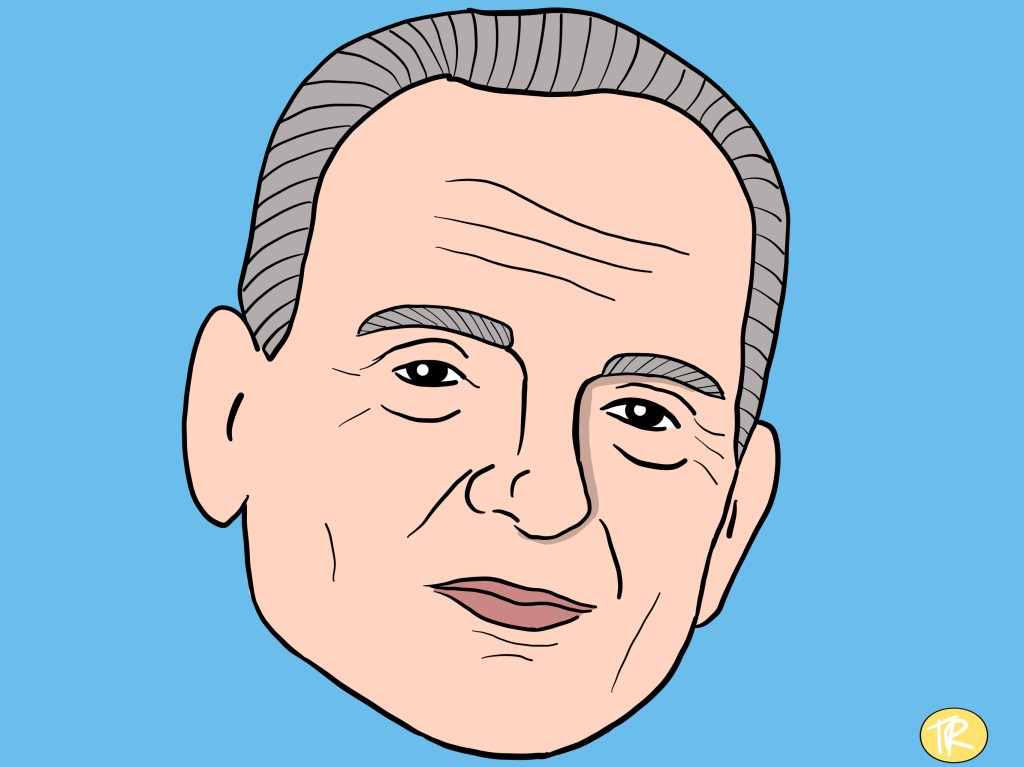
David Chase made two appearances on the Talking Sopranos podcast, hosted by Steve Schrippia (Bobby Baccalieri) and Michael Imperioli (Christopher Moltisanti). Both interviews included some great stories — several about Tony Sirico (Paulie Walnuts) — and some new insight into the show from its famously enigmatic creator.
Fittingly, Chase’s second appearance was a part of the podcast’s last episode, in which the pair discusses the series finale, Made in America, written and directed by Chase.
He still didn’t give a concise, clickbaity answer on the much-discussed ending, but I believe that he did divulge enough to finally indicate what his intentions were with that ubiquitous cut to black. Although he chose his words deliberately — both the ones he used and didn’t use — his message was obvious. Having been firmly in the “Tony is dead” camp, it surprised me to learn that the ending is a lot more hopeful than I’d realized.
The show’s central theme is consumerism
Chase expounds on the show’s main themes in both interviews, specifically citing consumerism and its effects on the country. One of the main focuses is “America lost in consumerism, certainly.”
“Consumerism is, in a way, kind of the theme of the whole show,” he says during the Made in America discussion. “The show is about money and death, when you boil it all down.”
Livia would’ve testified against Tony
The Talking Sopranos hosts asked Chase what the plans were for Livia Soprano, Tony’s mother, before Nancy Marchand’s sudden passing in 2000. Chase said the feds would have gotten Tony on RICO charges over the stolen airline tickets, and she would’ve testified against him at the trial.
In the season 2 finale, Funhouse, Tony angrily gives Livia airline tickets during an argument about her living situation, saying she can take her sister on a first-class flight to Tucson, Arizona, where their other sister lives. But Tony got the tickets from the Davey Scatino bust-out, and Livia is detained at the airport for possessing stolen airline tickets. Feds show up at Tony’s door with a search warrant, saying they’d already found other tickets in his vehicle. They cuff Tony and lead him away in front of Meadow and her friends. Tony is released in time for her graduation ceremony and party the next day.
The season ends with Tony’s legal future in jeopardy and viewers filled with dread, certain that Livia will fuck him over. And now we know that for sure.
Therapy did help Tony — but it didn’t help him become a better criminal
When asked if he felt that Tony got help through his therapy, Chase said yes. He said therapy left Tony more open to some of the “Buddhism” that started to pop up in the last year or so when he had the coma dream. “It made him more open.”
Chase noted that “a lot of critics say [Tony] got darker and darker and darker,” but he disagrees. While Tony certainly didn’t get lighter, he may have gotten more troubled, “but I don’t think he was more of an asshole than he’d ever been.”
“I think he got more interesting,” Chase said. “Also, I think [James Gandolfini] was getting darker.”
“His face was darker. His resting expression was dark,” he added.
Kupferberg was wrong about Tony
In The Second Coming (season 7, episode 7), Dr. Melfi’s shrink, Elliot Kupferberg (played by the magnificent Peter Bogdanovich), smugly tells her about a study that concluded that talk therapy enables sociopaths, helping them to become better criminals. The study comes up again in The Blue Comet (season 7, episode 8), during a dinner party, where Elliot reveals to the other guests that Melfi’s patient is Tony Soprano. Later, she reads the study and is convinced of its findings. During her next appointment with Tony, she ends their relationship, and that’s the last time we see her.
But Chase doesn’t believe that therapy made Tony a better criminal. “No. How would that happen?” he said.
“Every adult character on that show had made a deal with the devil. Starting with [Tony] and including Melfi.”
The owner of Holsten’s charged David Chase $15 for a hat
“When we went back to do [The Many Saints of Newark], I went into Holsten’s. And I didn’t know that they had Holsten’s hats. So I wanted one,” Chase said. “The guy charged me 15 bucks.”
Mikey Palmice took his death the hardest
Chase said that many actors took it hard when he delivered the news that their characters were getting killed off, but he listed two names in particular. One was John Fiore, who played Gigi. “He was not happy,” Chase said of Fiore, whose character died on the toilet. The other was Al Sapienza, who played Mikey Palmice.
Chase said Sapienza “never stopped” trying to talk him out of it. And this led to an anecdote about the indomitable Tony Sirico. During a read-through for Sapienza’s final episode, “everybody’s around the table and [Al’s] sitting there,” Chase said. “And Sirico comes into the room and sees him, and he goes, ‘bap bap bap bap,’” he said, wielding an imaginary Tommy gun.
Ralphie killed Pie-O-My
“Yeah,” Chase succinctly answered. Though, he added, the beating Tony gives Ralphie in Whoever Did This (season 4, episode 9) is about Tracy, not the horse.
What Tony “gets” when he trips on peyote
In Kennedy and Heidi (season 6, episode 18), Tony trips on peyote with Christopher’s old goomar. The episode ends with the pair watching the sunrise in the desert and Tony having an epiphany, yelling, “I get it!”
Specifically, Tony “gets” that “Christopher was a negative influence on his run of life,” David Chase said. But Tony’s profound realization extended beyond that — he got it, “the big it.”
Frank Vincent was up for the role of Uncle Junior
Frank Vincent was considered for the role of Uncle Junior, but Chase thought it was “too much Goodfellas. I wouldn’t have wanted him on the show much earlier than he ended up coming.” When they told Vincent that they were going in a different direction, he said, “Oh, I know what you’re gonna do. You’re gonna go with Dominic Chinese.”
Another interesting casting-related tidbit: Michael Madsen was pissed off at Chase for not casting him on the show. “He has a Chicago accent. I just couldn’t see it.”
Phil was in the closet
The allusions to Phil being in the closet were intentional, but Phil wasn’t conscious of it.
“I don’t think Phil was reflective enough to know what was going on inside,” Chase said.
The answer lies in the Journey
Imperioli: “The takeaway for me in that last scene is the line AJ repeats: ‘Didn’t you say to appreciate the good times,’ — to remember… that life is precious, life is short. That’s what I got this morning when I watched it.”
Chase: “Well, you’re absolutely right, and part of me would say that it’s bad writing, because it was stated so bluntly. And yet, people didn’t hear it.”
Again, that surprised me because I had been firmly convinced that the entire final season — especially the final episode — alluded to Tony’s inevitable death, and the final cut-to-black was that moment. “You probably don’t even hear it when it happens,” Bobby tells Tony in Sopranos Home Movies (season 7, episode 1) — but hearing this exchange between Imperioli and Chase shattered my certainty.
“If people think the show got darker, there’s nothing I can say. But if they think that after our conversation today, maybe they’ll go back and look at that scene again, and the music, and see what happens.”
Chase’s music choices were always painstakingly deliberate. Classic rock-loving Tony selects Journey’s “Don’t Stop Believing” on the jukebox at Holsten’s, and it’s the last thing we hear as the series comes to an end.
“Part of me would say that it’s bad writing, because it was stated so bluntly. And yet, people didn’t hear it.”
– David Chase, Talking Sopranos #91
 Inside Good, Outside Bad
Leave a comment